Sea Glass Identification: What Your Find Was & How Old It Is
Victor
Founder of Sea Glass Map
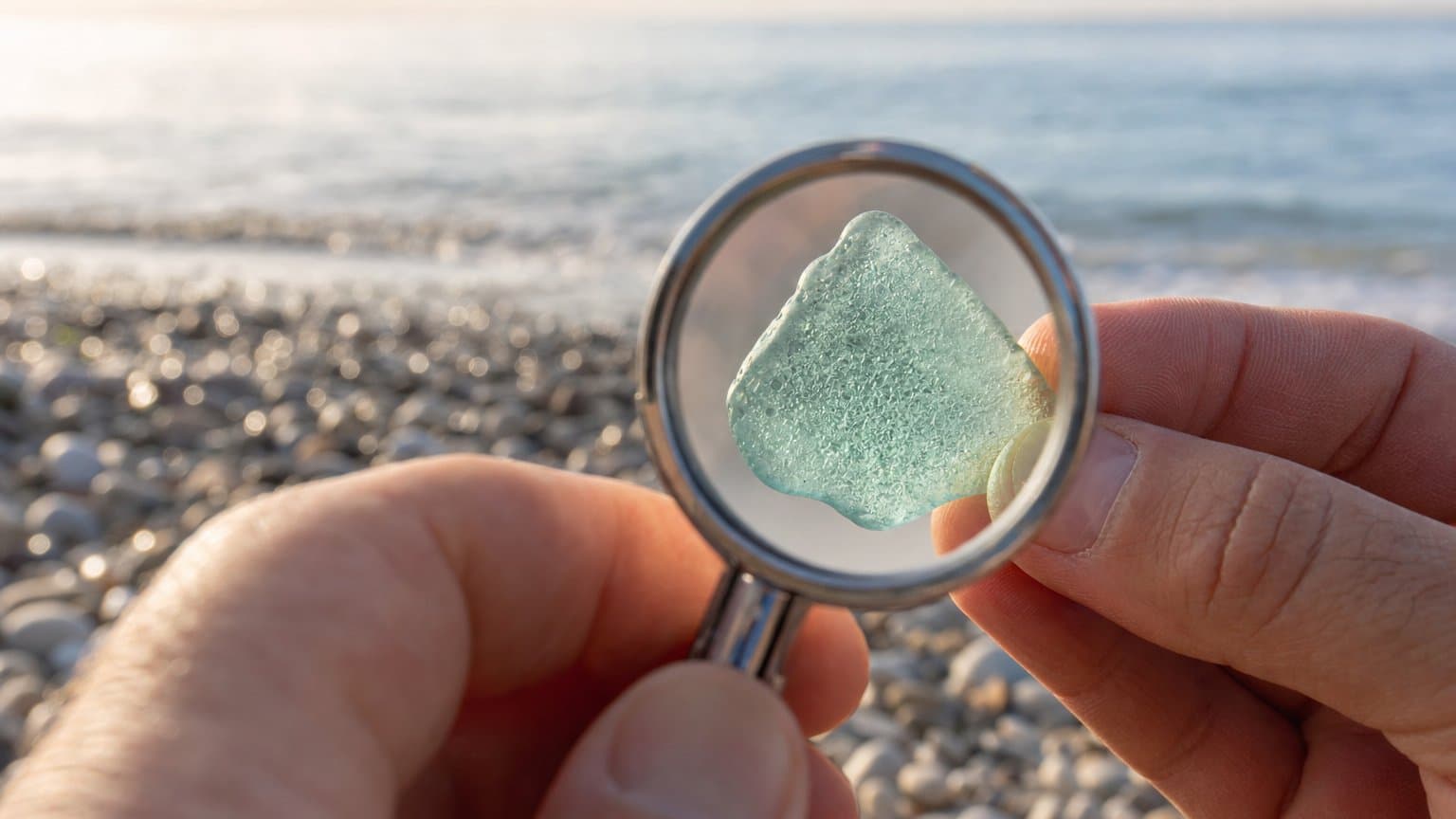
Most sea glass began as a bottle made between the 1840s and the 1960s, and you can identify a piece from three clues: its color, which narrows down what the bottle held and when it was made; its thickness and curve (soda and champagne bottles carried heavy glass to hold carbonation, medicine bottles were thin); and any surviving detail, like a mold seam, embossed lettering or the markings on a bottle bottom. A lavender piece was almost certainly a clear bottle from roughly 1870–1920, turned purple by decades of sun. A thick 'black' shard that glows olive-green against the light was probably a liquor or ale bottle from before 1880. And a frosted marble most likely escaped a Codd-neck soda bottle, smashed by a child more than a century ago.
Everything below comes from the world of historic bottle archaeology, above all the Historic Glass Bottle Identification & Information Website, the reference built by retired federal archaeologist Bill Lindsey for the Society for Historical Archaeology. Bottle collectors have spent decades working out which glass was made when; sea glass collectors inherit all of it, one frosted fragment at a time. Here is how to read your finds like an archaeologist. And if you want to know where a piece was found, that story starts on the map.
| Sea glass color | Most likely origin | Era clue |
|---|---|---|
| White (frosted clear) | Any bottle after ~1915; druggist bottles | Faint straw tint = after WWI |
| Brown | Beer, overwhelmingly; bitters; 1930s–60s bleach jugs | Yellowish 'old amber' = pre-1890 |
| Kelly green | Beer, wine and soda, often modern | Bright '7-Up' green = 20th century |
| Seafoam / aqua | Sodas, patent medicines, fruit jars, inks | Mostly before 1930 |
| 'Ball blue' | A Ball Mason jar, almost certainly | ~1909 to late 1930s |
| Lavender | Sun-turned clear glass (manganese) | ~1870 to 1920 |
| Cobalt | Poisons, Bromo-Seltzer, early sodas, inks | 1840s to 1930s |
| Teal / blue-green | Colored sodas and mineral waters | 19th century |
| Olive & 'black' glass | Wine, gin, pre-1880 liquor and ale | Black ≈ before 1880 |
| Milk white | Mason jar cap liners; cosmetics jars | 1870s – 1940s |
| True red | Gold-ruby glass; Schlitz beer bottles | Late 1940s to early 1960s |
| Orange | No common bottle was ever orange | The rarest for a reason |
What Was Your Sea Glass? A Color-by-Color Guide
White, brown and green: the everyday three
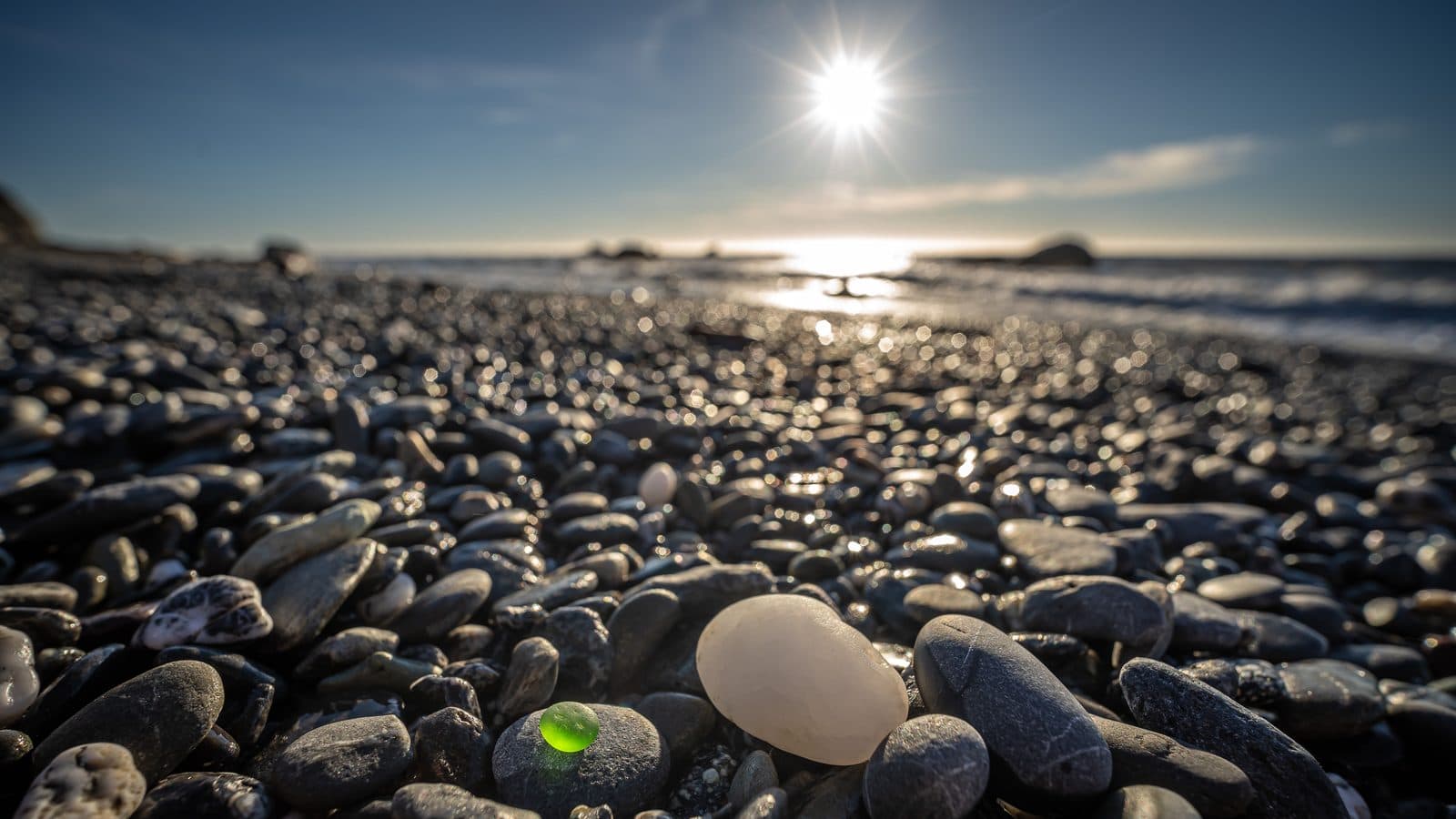
The three commonest sea glass colors are common because their bottles were made by the billion. White (frosted clear) took over once bottle machines standardized colorless glass in the mid-1910s, so a white shard can be anything from a 1920s milk bottle to last decade's jam jar. Brown is, before anything else, beer: amber glass blocks the light wavelengths that turn beer 'skunky', which is why it was and still is the default beer color. A yellowish, greenish-cast 'old amber' leans before 1890; and a brown shard with screw threads from the mid-20th century may be a Clorox bleach jug (glass until 1962) rather than a beer. Green is the hardest to date, since it has always been the color of beer, wine and soda, but the shade helps: brilliant '7-Up' green is almost exclusively 20th century, while a deep, subdued emerald could be a 19th-century mineral water or, surprisingly, a capers bottle, which was almost always made in dark emerald glass.
Seafoam, aqua and the one shard you can name
Soft blue-green aqua was the natural, undecolorized state of glass, the default for American workhorse bottles from 1800 until about 1930. Soda bottles are the biggest source: the Hutchinson sodas of 1880–1915 came in aqua more than 97% of the time, and collectors have catalogued over 20,000 different embossed varieties. Patent medicines, ink bottles and fruit jars fill out the family, and Coca-Cola's 'Georgia green' kept aqua alive long after everything else went clear. One aqua stands apart: the light but intense cornflower shade collectors call 'Ball blue'. Bottle archaeologists treat it as the rare fragment you can attribute with near certainty: it was the signature color of Ball Perfect Mason canning jars from about 1909 to the late 1930s. If your seafoam piece is unusually thick and curved, think of another story entirely: torpedo-shaped ginger ale bottles, shipped by the millions from Britain, many literally as ships' ballast.
Cobalt and teal: medicine, poison and Victorian soda
Cobalt blue was never a common bottle color, which is exactly why it is precious on a beach, and why it is so traceable. Three families made most of it: poison bottles, deliberately ribbed, quilted or studded so a hand in a dark cupboard would feel the danger (cobalt was the standard color for the lattice-textured ones); medicines, led by Bromo-Seltzer, whose little cobalt bottles were made from the 1890s right up to 1986 by the Maryland Glass Corporation; and early sodas and mineral waters of the 1840s–1900s, plus bulk ink bottles into the 1930s. One thing cobalt essentially never was: a whiskey bottle. Teal and blue-green pieces are strong age signals: those shades were rarely used once machines took over, so a teal shard usually reaches back into the 19th century.
Olive and 'black glass': the oldest thing on the beach
Hold a very dark shard up to strong light. If the thin edges glow deep olive-green or olive-amber, you have what early glassmakers called black glass, and probably the oldest find of your day. Black glass was the cheap, iron-rich workhorse of liquor, ale and wine bottles, mass-produced from the 1840s to about 1880 and increasingly rare after that; on historic sites it is the signature of the pre-1880 world. Lighter olive tones tell related stories: a flat olive panel with a beveled corner was likely a square case gin bottle, and a thick curved olive piece with part of a domed base (the 'kick-up', sometimes with a little nipple of glass at its center) is the fingerprint of a wine or champagne bottle, a shape that has barely changed since the 1840s.
Lavender, red and orange: the shortlist colors
Lavender sea glass is a beautiful accident of chemistry. From about 1870 to 1920, glassmakers decolorized clear glass with manganese; ultraviolet light slowly turns that glass purple, and decades on a sunny beach is exactly the UV dose the chemistry needs. So a lavender shard is clear glass from roughly 1870 to 1920, most likely after 1890, that the beach itself has tinted. (Deep, uniform purple in a whole bottle offered for sale is often artificially irradiated; the beach works slower and subtler.) True red was made with real gold dissolved in the glass, which priced it out of everyday bottles; the one famous exception is Schlitz's ruby-red beer bottles of the late 1940s to early 1960s, so most red sea glass traces to tableware, lanterns and warning lenses instead. Orange is the rarest sea glass color for the simplest reason of all: no mass-produced bottle was ever orange. An orange find is usually old tableware or a warning lens, and a genuine event. Curious how the full spectrum ranks? See the rarity chart in our complete sea glass guide.
Milk glass: the find hiding in plain sight
Opaque white pieces get overlooked as pebbles, but milk glass has two lovely origin stories. Flat discs and disc fragments are usually Mason jar cap liners, the white glass inserts inside zinc canning lids, made until the Second World War, when the zinc went to the war effort. Curved pieces lean toward cosmetics: cold cream and ointment jars and lotion bottles, milk glass's home turf from the 1870s to the mid-20th century. The field test: held to bright light, the thin edge of true milk glass glows a faint orange.
How Old Is My Sea Glass? Five Signs of Age
- The tint of 'clear' glass. A lavender blush means manganese chemistry: ~1870–1920. A faint straw-yellow tint means selenium: machine-made, from about 1912 into the 1950s. Wet the piece, since frosting hides faint tints.
- Bubbles and texture. Seeds and bubbles in the glass, or a wavy, hammered 'whittle' surface, point to mouth-blown or early machine glass, mostly before the late 1920s. Treat it as supporting evidence rather than proof.
- Thickness. Carbonation demanded heavy glass: thick shards suggest soda, beer, champagne or mineral water. Medicine bottles ran thin. Wartime and later bottles thinned out generally, so chunky glass leans older.
- A mold seam. A hair-fine seam that would have run over the bottle's lip is machine-era (after 1905, usually after 1910). A thicker seam that faded out below the lip is mouth-blown, likely 1880s–1910s.
- The 'black glass' test. If a near-black shard backlights to deep olive, you are probably holding the 19th century: most black glass predates 1880.
Stack the clues rather than trusting any single one. Even professionals only date a bottle to within 10 or 15 years from its manufacturing features. And remember that bottles were refilled and reused for years, then tumbled for decades: a piece's story is always longer than its manufacture date.
How to Read a Sea Glass Bottle Bottom
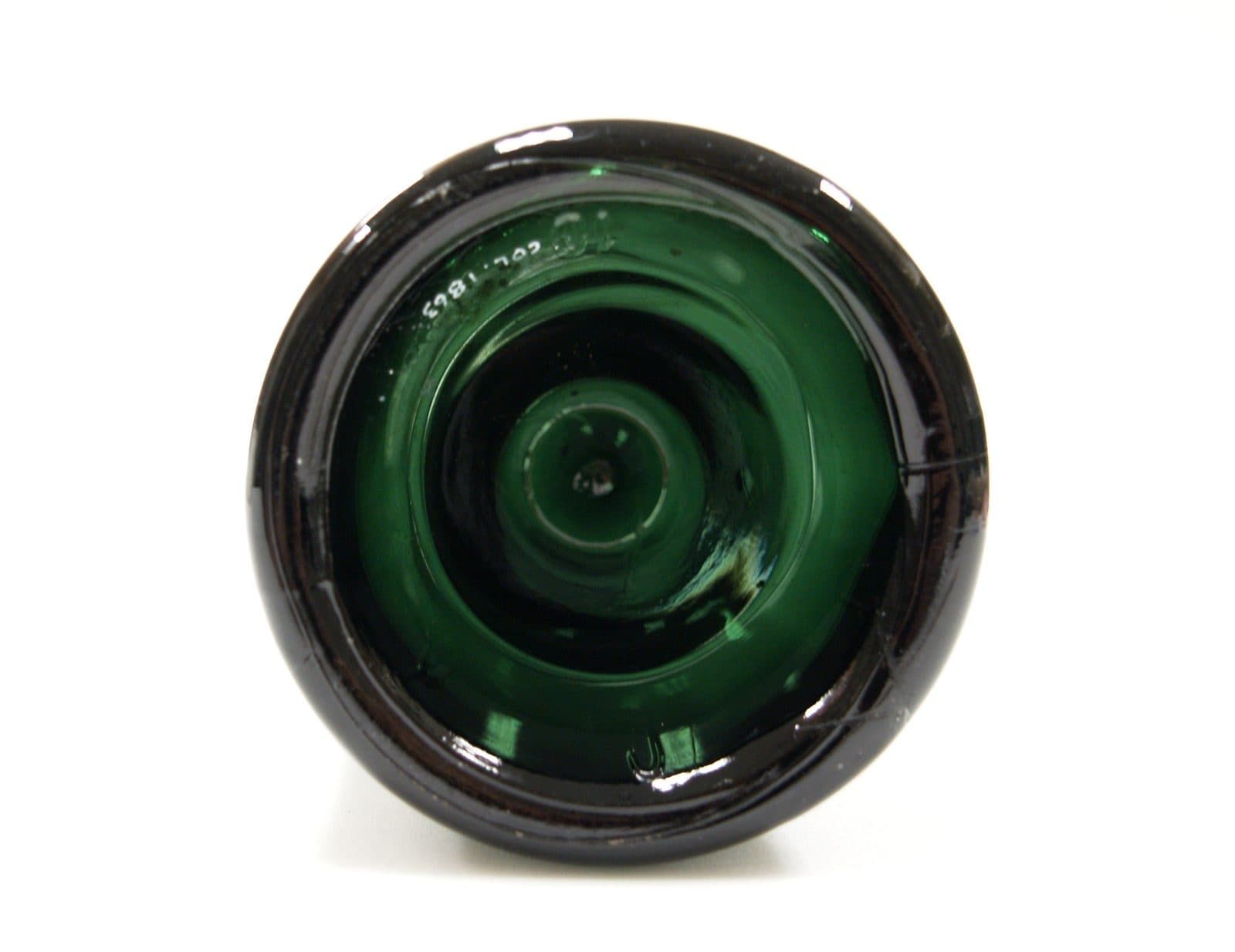
Bottle bottoms are the jackpot of identification, the piece where glassmakers left their fingerprints. Work through four steps:
- Feel the center. A rough scar (a ragged ring, a scatter of glass chips, or a reddish-black metallic deposit) is a pontil mark, where a rod held the bottle while its lip was finished by hand. Pontil scars mean before ~1870, most likely 1840s–1860s: the oldest sea glass most collectors will ever hold.
- Trace the circles. A thin off-center circle with a feathered, splotchy edge is the suction scar of the Owens bottle machine: 1905 onward, and the feathering says before the late 1920s. A crisp small incised dot you can catch a fingernail on is a valve mark: a milk bottle or food jar, early 1900s–1940s. A clean circle with no feathering is a later machine bottle, 1920s to today.
- Check the texture. A ring of tiny raised dots (stippling) around the resting edge? That process started in 1940, which makes it instant dating. Script letters spelling *Duraglas* pin it to 1940–1963.
- Read logos, not lone numbers. A diamond with an oval and an I is Owens-Illinois, 1929 to the late 1950s, and it comes with a date: the number on its right is the year (a '6' in the 1930s–40s, a two-digit '46' = 1946 from the mid-forties). An H over an A is Hazel-Atlas (1923–1982); an anchor is Anchor Hocking (1938 on); cursive *Ball* script is the jar giant. On British beaches look for C.S & Co (Cannington Shaw, 1875–1913), UGB (1913–1968) or KILNER. A number with no logo is just a mold number. It dates nothing.
Marbles, Stoppers and Other Mystery Finds
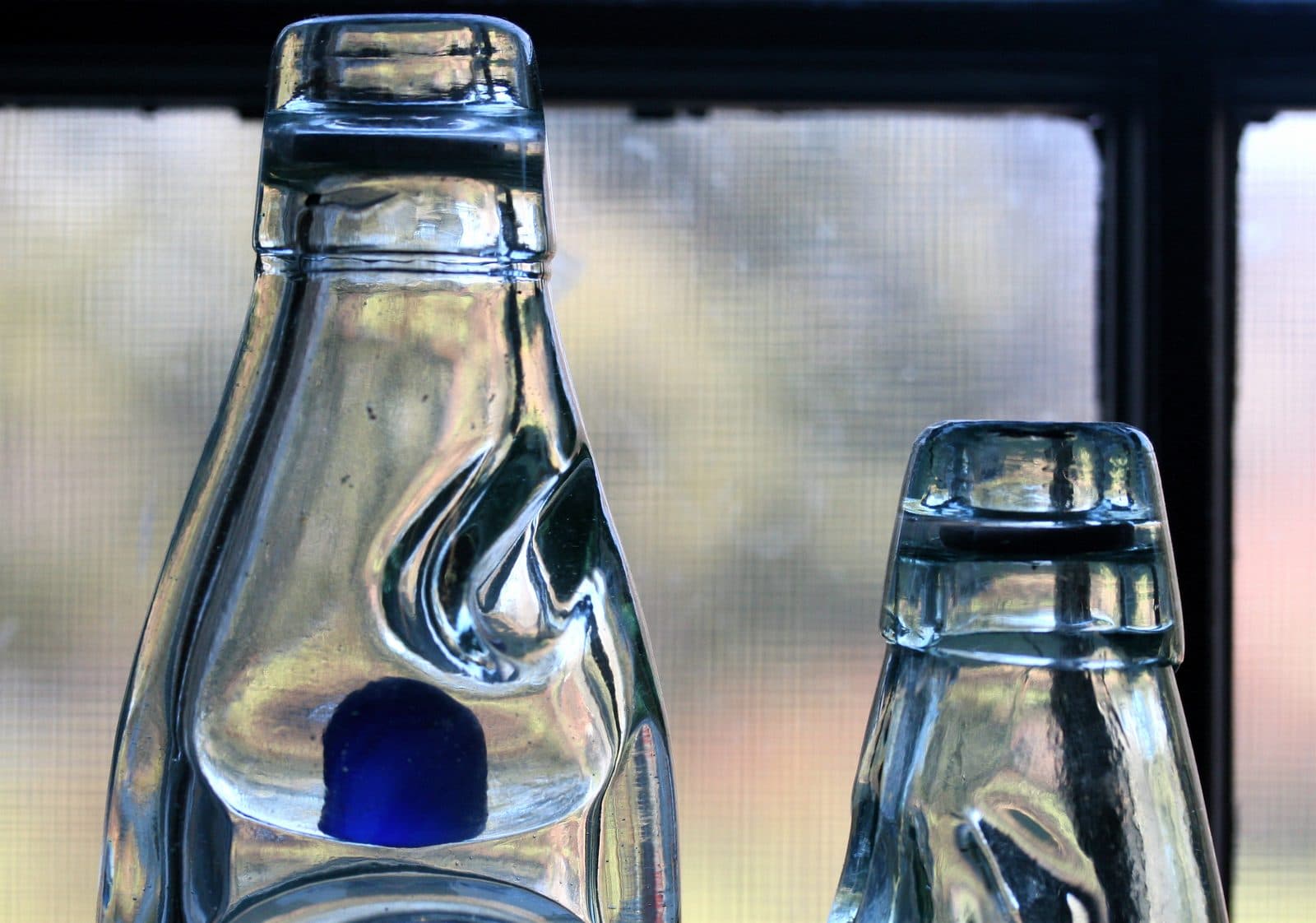
Some finds aren't bottle walls at all. Sea glass marbles are the best story on the beach: in 1872, Hiram Codd patented a soda bottle sealed by a glass marble held against a rubber ring by the fizz itself. The bottles were everywhere in Britain and the Commonwealth, and children smashed them to get the marble, which was made twice as hard as the bottle around it. That hardness is why the marbles survived a century of surf. Frosted glass discs are usually those Mason cap liners; thick glass stoppers come from decanters, cruets and chemist bottles; and a bottle neck is datable in its own right: a lip with a seam running over its top is machine-made (post-1905), while a lip that looks folded or applied by hand reaches back into the 1800s. If your mystery piece has softened painted lettering, it may be an ACL soda bottle; painted labels arrived in 1933. And glazed shards with a pattern aren't glass at all but sea pottery, a hobby of its own.
How Sure Can You Be?
It depends on the piece. Bottle archaeologists estimate that on a small unmarked fragment, even an expert finds an identifiable feature only somewhere between 1 time in 6 and 1 in 50, depending on how the bottle was made, and fewer than 40% of bottles carried embossing even in their heyday. Frosting erases fine detail; the sea keeps what it wants. So treat every identification as a probability rather than a verdict. 'Almost certainly a Ball jar' is as good as it gets, and that's part of the charm. A brown shard is a beer bottle until proven otherwise; a lavender one is a century old on chemistry alone.
When you log a find on Sea Glass Map, you record the colors you saw at a spot, and every logged color helps the next collector read their own finds against what a beach actually produces. The glass is history, and the map is how we keep reading it together. For where to hunt in Britain, start with our UK beach guide: Seaham's famous 'multis' are end-of-day factory glass with an identification story all their own.
Frequently asked questions
How can you tell how old sea glass is?
Stack several clues: color (lavender means manganese-decolorized clear glass, roughly 1870–1920; a straw tint means 1912 onward), thickness (heavy glass suggests older carbonated-drink bottles), bubbles and whittle texture (mostly pre-late-1920s), mold seams, and base markings like pontil scars (pre-1870), Owens suction scars (post-1905) or stippling (post-1940). Even experts only narrow a bottle to a 10–15 year window from these features.
What was black sea glass originally?
'Black' sea glass is almost always very dark olive-green or olive-amber glass from liquor, ale and wine bottles, mass-produced from the 1840s to about 1880. Hold it to strong light: if the thin edges glow olive, it's black glass, and probably the oldest piece you'll find; the color largely disappeared after 1880.
Where do sea glass marbles come from?
Mostly from Codd-neck soda bottles, patented by Hiram Codd in 1872, which used a glass marble held by carbonation pressure as the stopper. Children smashed the bottles to get the marbles, which were made twice as hard as the bottle glass, hard enough to survive a century of tumbling. They're most common on British and Commonwealth beaches, where Codd bottles dominated.
Why is some sea glass purple or lavender?
Between about 1870 and 1920, clear glass was decolorized with manganese, and manganese glass slowly turns purple under ultraviolet light. Decades of sun on a beach is exactly that UV dose, so lavender sea glass is clear glass from roughly 1870–1920 that the beach itself has tinted purple.
What bottles did cobalt blue sea glass come from?
The three big sources are poison bottles (textured with ribs and bumps as a touch warning, most commonly cobalt), medicine bottles like Bromo-Seltzer (cobalt from the 1890s to 1986), and colorful sodas and mineral waters of the 1840s–1900s, plus bulk ink bottles. Cobalt was essentially never used for whiskey bottles.
 United Kingdom
  United States