All articles
GuideUpdated August 30, 2026 15 min read

What Is a Glass Beach? How They Form, and Where They Are

Victor

Founder of Sea Glass Map

What Is a Glass Beach? How They Form, and Where They Are
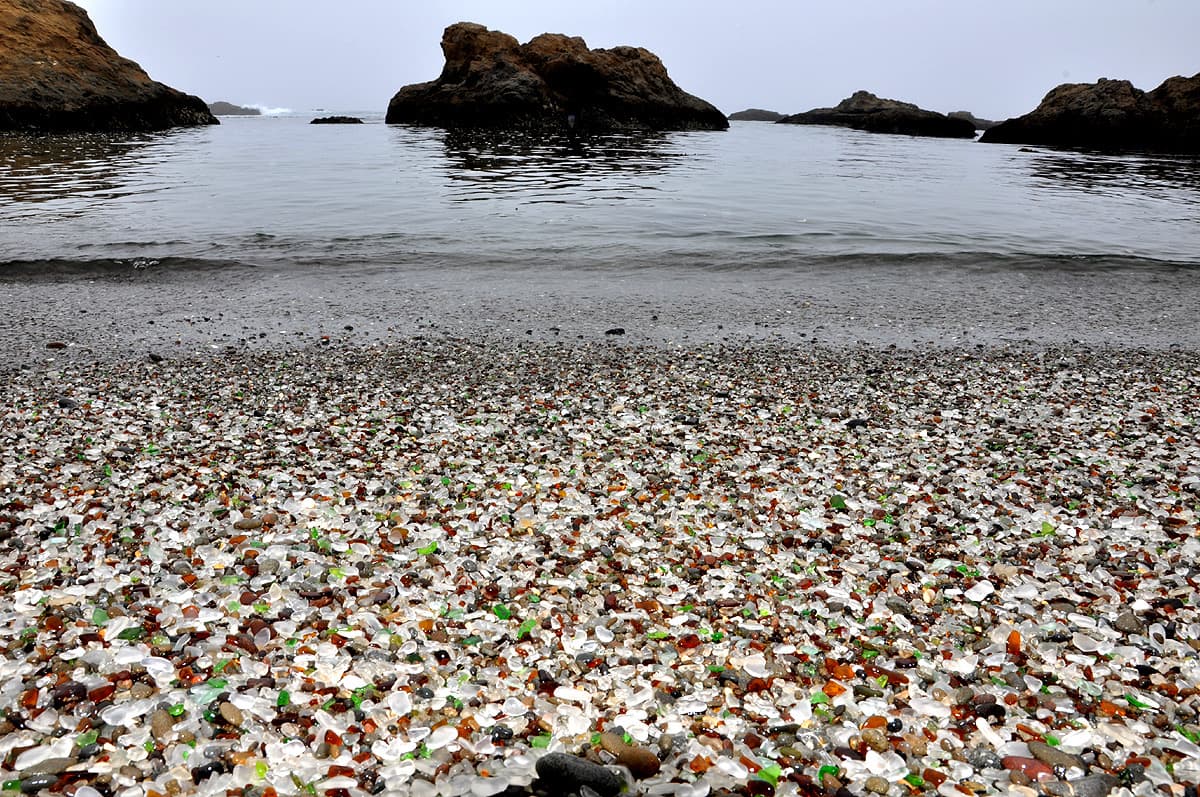
Photo by Moximox, CC BY-SA 4.0

A glass beach is a shore where broken glass has been tumbled smooth by the sea in such quantity that it replaces the sand or shingle underfoot. Every one of them was made by people. Behind almost all of them is a rubbish dump that a town pushed over the nearest cliff, or a bottle factory that tipped its waste into the sea, and behind one of them, in Japan, is a local authority that laid crushed glass on the shore on purpose. About a dozen places worldwide genuinely carry the name, from Glass Beach at Fort Bragg in California to Steklyannaya Bay in the Russian Far East. Most are visibly running out, and at several of them, Fort Bragg, Kauai and Bermuda among them, taking glass away is now prohibited.

The name has travelled further than the places have. People search for a glass beach in Iceland, in Crete, in Ireland, and there is not one in any of them, which is not at all the same as saying there is no sea glass there. This guide covers both halves of that: the beaches that earned the name and what is honestly left of each, and what to do when your country is not on the list. Every beach named here is pinned on Sea Glass Map by the people who actually walk it.

BeachWhereTake glass?What is there now
Glass Beach, Fort BraggCalifornia, USANo: state parkThinned, and visibly so
SeahamCounty Durham, EnglandYesStill the richest in Europe
Steklyannaya BayPrimorye, RussiaNo: signs ask you not toA band along the waterline
Glass Beach, Port AllenKauai, HawaiiNo: please leave itOver 99 percent gone
Glass Beach, BeniciaCalifornia, USAYes: city beachPicked over, patient work
Glass Beach, Port TownsendWashington, USAYesJewellery grade, if you walk for it
Glass Beach, KodiakAlaska, USAYesSmall, and picked hard
Glass Beach, SidneyBritish Columbia, CanadaYesWhite and amber at low tide
Glass Beach, Ireland IslandBermudaNo: bags are checked at the airportThe whole shingle is glass
Glass Beach, RobeSouth AustraliaYesBrown, white and green, some lettering
Kunjita, or Sea Glass BeachOkinawa, JapanYesPlenty of it, but young
Glass Beach, OmuraNagasaki, JapanIt is not sea glassLaid down on purpose in 2016

Why Is There So Much Glass on a Glass Beach?

Glass is not a natural beach material. For a shore to be paved in it, somebody has to have put an enormous quantity of glass into the sea at one spot, and then left it alone for fifty years or more. In practice that has happened in three ways. Most often a coastal town used the nearest cliff as its tip, which is the story at Fort Bragg, at Steklyannaya Bay, at Robe and on the ground above Port Allen. Sometimes a single factory did the dumping: Seaham had the largest bottleworks in Britain pouring its rejects into the North Sea for seventy years. And once, at Omura in Japan, a local authority laid crushed glass along the shore deliberately, for a reason that had nothing to do with beaches at all.

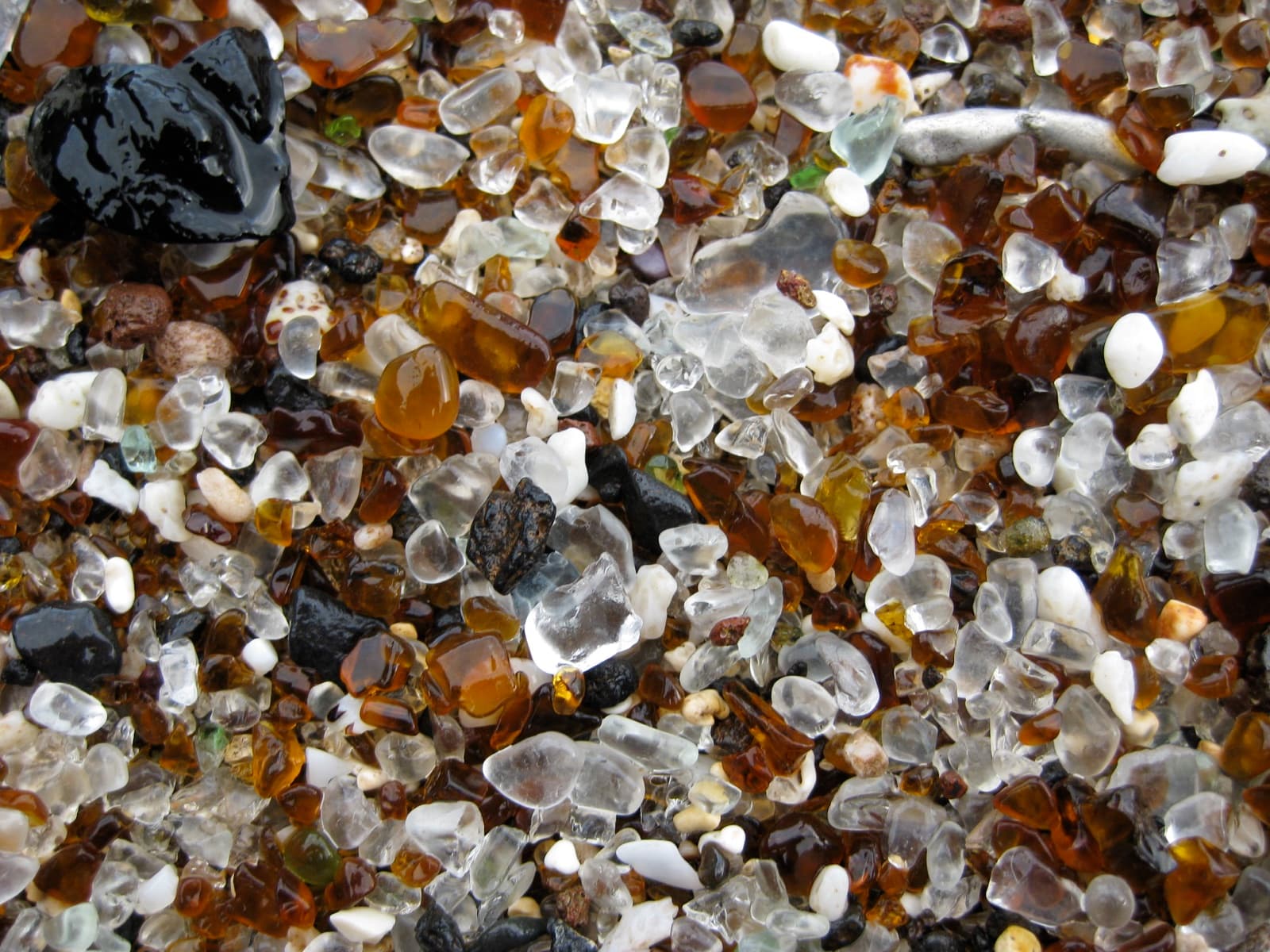
The sea then treats all of it the same way. Surf and gravel work as a tumbler, so the edges go first. Then the surface clouds, because seawater slowly leaches sodium and calcium out of the glass and leaves a microscopically pitted skin behind, which is the frosting that tells you a piece has spent decades in the water rather than a season. Thirty years is a reasonable minimum for a properly finished piece, and the best of what washes up at Seaham has been at it for over a century. If you want the full account of how a bottle becomes a gem, we wrote one in what sea glass is.

Which leads to the fact that shapes every one of these beaches. The dumps closed decades ago. Nothing is being added. Every glass beach on earth is working through a deposit that stopped growing before most of its visitors were born.

The Glass Beaches That Were Rubbish Dumps

Glass Beach, Fort Bragg (California, USA)

The most famous sea glass site on earth, and the one you cannot collect on. Fort Bragg ran three town dumps in sequence over these cliffs into the Pacific from 1906 until 1967, and the sea spent the following decades grinding the last of them into a shingle so bright that the cove became a destination. The destination then wore it out. The main beach was folded into MacKerricher State Park in 2002, collecting is prohibited, there are signs through the park and rangers patrol it, and the park superintendent has said plainly that the amount of glass has greatly diminished. It shows. Come at low tide, when the wet glass lights up, and come to look. See the Glass Beach, Fort Bragg spot, and our California guide for the beaches nearby where you may fill a pocket.

Steklyannaya Bay (Primorye, Russia)

Steklyannaya means glass, and the bay near Vladivostok earned the name the ordinary way: a municipal dump ran above the cove from 1967, and decades of Sea of Japan surf turned its bottles, its tiles and the local porcelain factory's rejects into a shingle of glass and patterned china. Green, brown and clear dominate, with blue turning up now and then, and the broken porcelain is the detail that makes this beach unlike the others. It is also the clearest warning on the list. Signs in Russian, English and Chinese ask visitors to take nothing, and by 2025 most of the cove is bare ground with the colour concentrated in a band along the waterline. Go in low morning sun, when the wet strip at the water lights up, and leave with photographs. See the Steklyannaya Bay spot.

Glass Beach, Port Allen (Kauai, Hawaii)

The saddest entry, and the most useful one. Port Allen's Glass Beach was a shingle of tumbled glass fed by the industrial dump on the ground above it, and by 2024 local reporting put it at over 99 percent gone, carried off in pockets and jars a handful at a time. What is there today is small fragments among the volcanic rock, brown and green with the odd aqua, and hand-lettered signs asking you plainly to leave them. Please do. It is a short walk from Port Allen and it is still worth seeing, precisely for what it says about what happens to a beach that becomes a destination. See the Glass Beach, Port Allen spot.

Glass Beach, Robe (South Australia)

Robe is the one town on this list that tells you the story openly. The cove below the Cape Dombey obelisk is Factory Bay, which was a canning factory and then the town's rubbish dump after the wars, and the hotels' green and brown bottles came back as sea glass. Brown, white and green lead, with seafoam, teal and light blue turning up, and some pieces still carry lettering. The cove is only reachable at low tide and the glass concentrates toward the cave at the right-hand end, often a footstep down. Go on a calm day, because the swell here rises quickly and has caught people out. See the Glass Beach, Robe spot and our Australia guide.

Glass Beach, Kodiak (Alaska, USA)

Kodiak has the best origin story of any beach here. The glass is the stock of a local bar, swept into the sea by the 1964 Great Alaska Earthquake, the strongest ever recorded in North America. Sixty years of Gulf of Alaska surf later, multicoloured pieces still scatter the shore at the eastern edge of Kodiak Bay. Finding it is the hard part and visitors on the wrong trail come home empty: park in the pullout on Rezanof Drive just before the Boy Scout Lake parking, and take the old road from the yellow gate down toward the shore. The beach is small, so it only shows at low tide, and locals say it gets picked hard these days. Make noise on the trail, for the bears. See the Glass Beach, Kodiak spot.

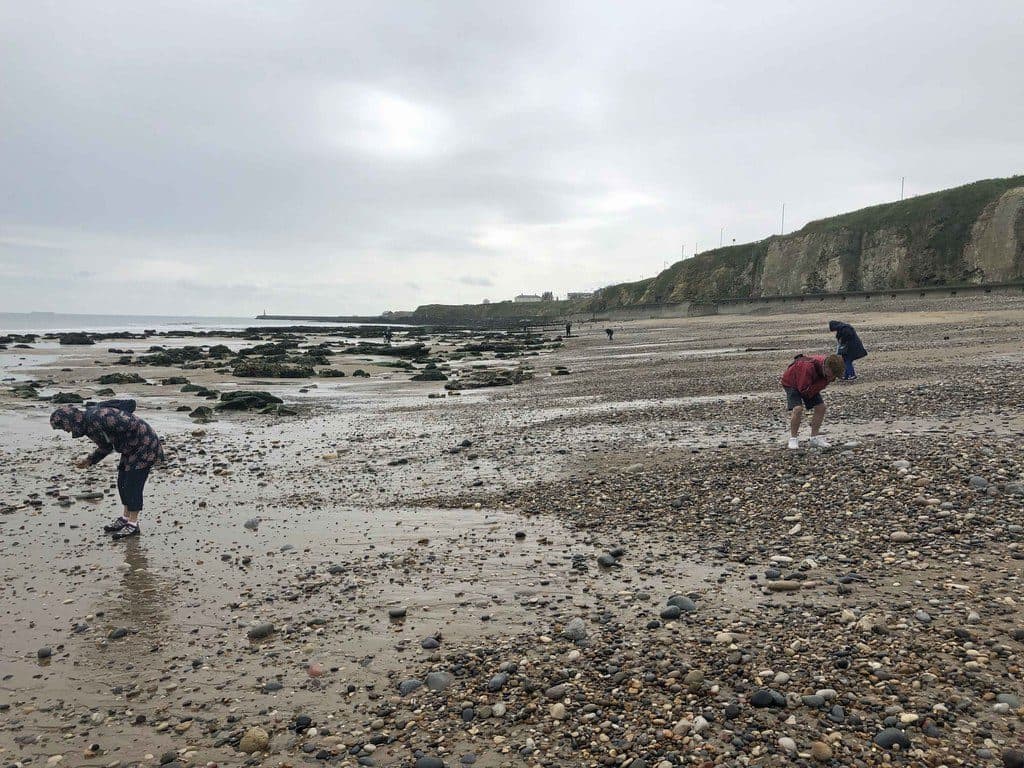
Pebble beach at Seaham, England, a classic sea glass shoreline
Pebble beach at Seaham, England, a classic sea glass shoreline · Photo by Steve Daniels

The Glass Beaches That Were Factories

Seaham, the UK's glass beach (County Durham, England)

There is no beach in Britain officially called Glass Beach, and if you are looking for one, the answer is Seaham. From 1850 to 1921 the town was home to the Londonderry Bottleworks, reported as the largest bottle-making works in the country, turning out up to 20,000 hand-blown bottles a day and tipping its waste glass straight into the North Sea. A century of surf later it is still coming back, and Seaham is the richest sea glass shore in Europe by a distance: clear and green above all, because that is what the works made most of, but also yellow, red, blue, aqua, milk glass in pastel shades, and the multicoloured pieces collectors call multis, which are fused offcuts from the furnace floor. Come at low tide after a rough sea. Collecting is fine here. See the Seaham Hall Beach spot and our UK guide for the rest of the coast.

Glass Beach, Sidney (British Columbia, Canada)

A tiny pocket beach on the Sidney waterfront, and one of the few places that made the name official: the town named it Glass Beach itself. Two sources fed it, which is unusual. Sidney barged its rubbish out into the channel for years, and a glass factory on the waterfront burnt down in the 1950s. White and amber are still plentiful along the waterline at low tide, though locals will tell you the rarer colours get picked over quickly now. Twelve steps down from the Waterfront Walkway, between Beacon Park and the fishing pier, which makes it the easiest beach on this list to reach. See the Glass Beach, Sidney spot and our Canada guide.

The One That Was Built on Purpose

Glass Beach, Omura (Nagasaki, Japan)

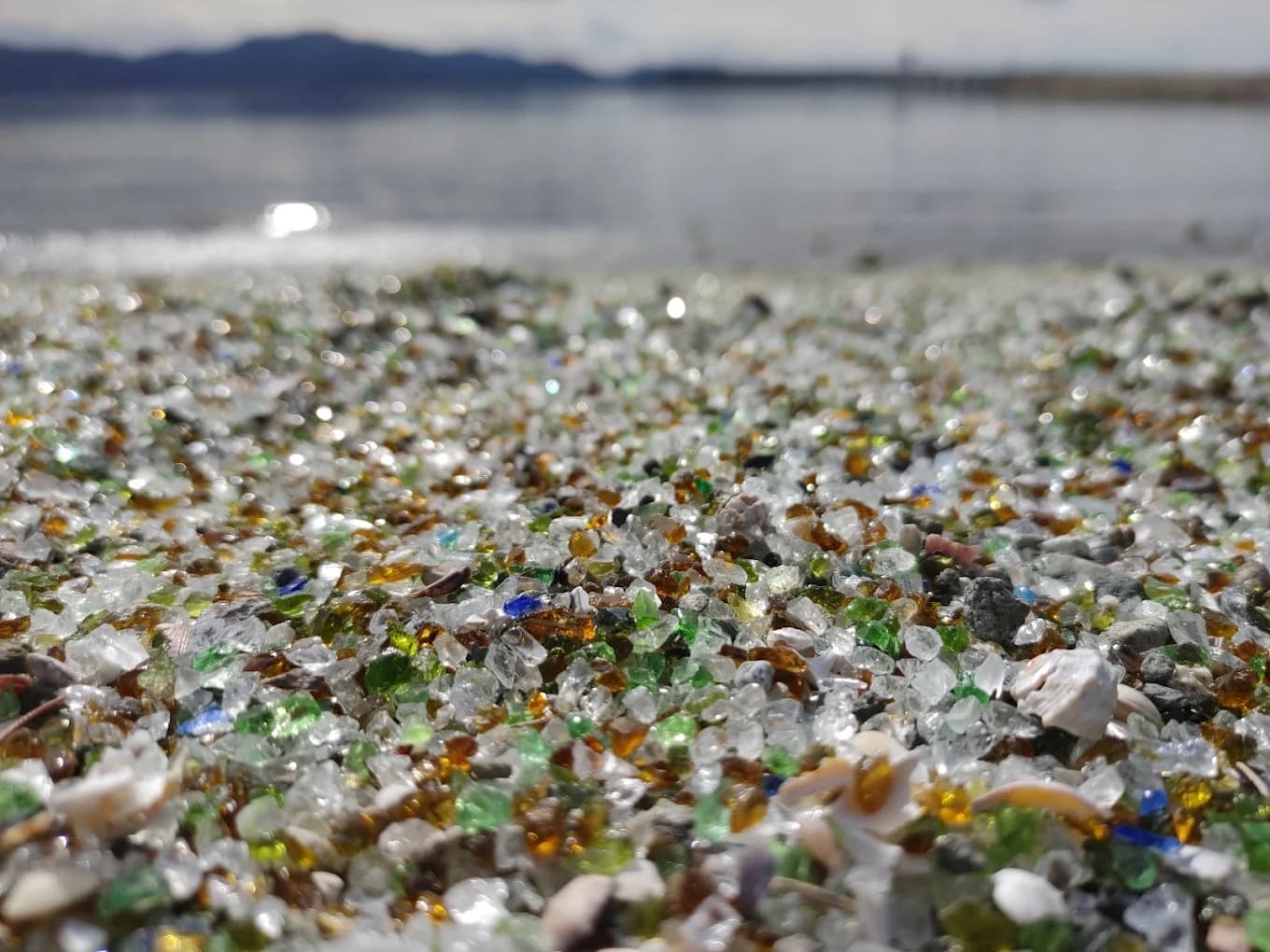
Japan's Glass Beach, near Nagasaki Airport at Omura, is the exception that explains the rule. It is not sea glass and it is not old. In 2016 the shore was laid with crushed recycled glass, on purpose, because the rocky ground it replaced grew algae that rotted and stank across Omura Bay through the summer. Glass gave the algae nothing to hold on to. The side effect was a beach that glitters in a rainbow across the water toward the airport, and it has become a photograph people travel for. It is worth knowing about for two reasons. If you are searching for a glass beach in Japan, this is almost certainly the one you have seen, and it is not what the others are. And it is the cleanest possible demonstration of the point: if a shore is paved in glass, somebody put it there. The only question is whether they meant to.

For actual sea glass in Japan, go to Okinawa. Kunjita, on the Pacific side of Toyohara and commonly known as Sea Glass Beach, is a 500 metre strand with a lot of glass in the full range of colours, cobalt included, though most of it is young: few pieces have the thick, deeply frosted look of an old dumping coast and many still carry an edge. See the Kunjita Beach spot.

The Other Beaches That Carry the Name

Four more are worth knowing, and they are the ones where you can generally work rather than only look.

  • Glass Beach, Port Townsend, Washington. Probably the richest glass beach in America you may lawfully collect on, and it makes you earn it: a nine kilometre round trip along the shore from North Beach County Park out to McCurdy Point, with the tide deciding whether you get back. There are few escape routes under the bluff, so read the tide table before you set out rather than after. Jewellery grade glass, marbles and old china, with cobalt in quantity. See the Port Townsend spot.
  • Glass Beach, Benicia, California. A pocket beach on the Carquinez Strait below a bluff where, by local account, a bar tipped its bottles for decades. Clear, green and amber along with old bottle bottoms and crockery. It floods completely at high water, so go at low tide, and expect patient work rather than the carpet in the photographs. See the Benicia spot.
  • Glass Beach, Ireland Island, Bermuda. The whole shingle is glass, green and white and brown with some blue, twenty minutes on foot from Kings Wharf. A sign says you cannot take any of it and they mean it, because the airport checks bags on the way out. Go early, before a cruise ship is in. See the Ireland Island spot.
  • Sea Glass Beach, Playa Cofi, Vieques, Puerto Rico. The best known on the island, just west of the Isabel Segunda ferry terminal, reached by a steep road and a short set of stairs. It gets picked over, so low tide along the waterline and in the shallows is your chance. See the Playa Cofi spot.

Thailand has one too, at Hat Hin Muad Sila on Koh Si Chang, probably the richest in the north of the country. People collect there daily. The path down from the road is broken and the stairs are genuinely dangerous, so the sensible approach is from the Novotel side on a very low tide.

Is There a Glass Beach in Iceland, Greece or Ireland?

No, and this is the most common disappointment in the whole subject, so it is worth answering properly.

Iceland has no glass beach. What it has, and what people are usually picturing, is Diamond Beach on the south coast, where stranded blocks of glacier ice sit on black sand. That is ice, not glass. Iceland does have real sea glass, though: the stony foreshore at Seltjarnarnes, on the coastal path out toward the Grótta lighthouse a few minutes from central Reykjavik, gives up white, seafoam and bottle green between the pebbles. Expect a few pieces on a good tide rather than a haul, mind the seasonal closure of the reserve for nesting terns, and take the glass while leaving the stones and the sand. See the Seltjarnarnes and Grótta shore spot.

Greece and Crete have no beach named Glass Beach either, and no factory carpet like Seaham's. What Greece has instead is three thousand years of harbour life, which seeded the shores of the old ports with frosted glass, and the wind doing the tumbling that tides do elsewhere. It works: the beach under the Temple of Poseidon at Sounion, Grotta on Naxos and Elli in Rhodes Town all produce. Rhodes is the interesting one for this article, because Beachcombing Magazine traced the glass on its beaches to the cliff of a landfill next to the sea, dislodged by winter Aegean swell. Same mechanism as Fort Bragg, no name and no fame. Crete has sea glass around Chania but no famous site, and we have no Cretan beach mapped yet. Our Greece guide has the rest.

Ireland has no Glass Beach, and the search results are a coincidence worth explaining: the Glass Beach in Bermuda sits on an island called Ireland Island, which is what most of those searches turn up.

The general rule is a useful one. Almost every country has sea glass and almost none has a glass beach, because the name needs a very particular accident: a large dump, in one place, next to surf, abandoned long enough ago. If your country is not on this page, look for old harbours, Victorian resorts, and anywhere a town used to burn or bury its rubbish near the water.

Winter surf working a sea glass beach
Winter surf working a sea glass beach · Photo by Russel Wills, CC BY-SA 2.0

Can You Take Glass from a Glass Beach?

It depends on the beach, and the famous ones are the strictest.

  • No at Fort Bragg. It is inside MacKerricher State Park, where park rules protect the glass both as beach material and as a historical object. California State Parks has said publicly that it does not want anyone collecting sea glass anywhere on its coast.
  • No at Port Allen, Kauai. Not a legal ban so much as a plea, in hand-lettered signs, on a beach that is already over 99 percent gone.
  • No in Bermuda. Signed, and enforced at the airport.
  • Asked not to at Steklyannaya Bay. Trilingual signs, and a cove that is visibly bare where it used to be paved.
  • Yes at Seaham, Benicia, Port Townsend, Sidney, Kodiak, Robe, Vieques and Okinawa. These are ordinary public beaches, and a pocketful of what is legally litter is fine.

Two things hold everywhere. Sand, pebbles, shells and stones are not yours to take, whatever the rule on glass: the exception the law tends to make is for the rubbish, which is exactly what sea glass is. And a rule that permits a pocketful has never permitted a bucket. We went through this country by country in Can You Take Sea Glass Home?.

Why Glass Beaches Are Running Out

This is the part the photographs never show, and it is not really an argument, it is arithmetic. Every one of these beaches is a closed deposit. Fort Bragg's last dump shut in 1967, Seaham's bottleworks in 1921, Steklyannaya Bay's tip in the eighties. Nothing is going in. Meanwhile the beach became findable, then popular, then a stop on an itinerary, and each visitor takes a small handful that seems like nothing.

The results are measurable rather than sentimental. Port Allen is over 99 percent gone. Steklyannaya Bay is mostly bare ground with a band of colour left at the waterline. Fort Bragg's own park superintendent describes the glass as greatly diminished, which is why it is protected at all. None of these places is coming back, because the only thing that could restock them is another century of somebody dumping their rubbish in the sea.

That is why we never rank finds by rarity or resale value on Sea Glass Map, and never will. A frosted white from a beach you love is worth the same as a red. Treating a finite beach as a scoreboard is precisely how these places emptied.

How to Visit a Glass Beach Well

  • Check the rule before you go, not on the sand. Half the famous ones are look-only, and the signs are easy to miss when the ground is glittering.
  • Go at low tide. Every beach here shows its glass at low water, and several, Benicia and Robe among them, barely exist at high water.
  • Go after a storm, and in winter if the coast has one. Swell turns the seabed over and puts fresh material up the beach. A calm week in August is the worst time to arrive.
  • Leave the young pieces. Anything still shiny or sharp has not finished. Left alone it becomes what you came for; in a jar it stays half-made forever.
  • Take a photograph instead, where the beach is thin. At Fort Bragg, Port Allen and Steklyannaya Bay this is the whole visit, and it is still worth the trip.
  • Log what you find. If you walk one of these, pin it on Sea Glass Map with a photo and a note on what the beach is like now. The state of these places changes faster than any guide, and a recent report is worth more than an old one.

Frequently asked questions

What is a glass beach?

A glass beach is a shore where tumbled, frosted glass replaces the sand or shingle underfoot. Every one is man-made: almost all began as a rubbish dump a town pushed over the cliff, or as the waste of a bottle factory tipped into the sea, left long enough for the surf to grind it smooth. About a dozen places worldwide genuinely carry the name, and most are running out.

Where is the most famous glass beach in the world?

Glass Beach at Fort Bragg, California, fed by three town dumps that ran over the cliffs into the Pacific between 1906 and 1967. It is inside MacKerricher State Park, so collecting is prohibited and the glass has thinned noticeably. Seaham in County Durham, England, is the richest one you can still legally collect on.

Is there a glass beach in the UK?

No beach in Britain is officially called Glass Beach, but Seaham in County Durham is what people mean. The Londonderry Bottleworks tipped its waste into the North Sea there from 1850 to 1921, at up to 20,000 bottles a day, and it is still washing back as clear, green, blue, red and multicoloured pieces. Collecting is allowed. Come at low tide after a rough sea.

Can you take glass from a glass beach?

It depends on the beach. Collecting is prohibited at Fort Bragg (state park) and in Bermuda (checked at the airport), and asked against at Port Allen in Kauai and Steklyannaya Bay in Russia, all of which are visibly depleted. It is fine at Seaham, Benicia, Port Townsend, Sidney, Kodiak, Robe, Vieques and Okinawa, which are ordinary public beaches. Sand, stones and shells are off limits everywhere.

Is there a glass beach in Iceland?

No. People are usually thinking of Diamond Beach on Iceland's south coast, where blocks of glacier ice sit on black sand, which is ice rather than glass. Iceland does have real sea glass, notably on the stony foreshore at Seltjarnarnes near the Grótta lighthouse outside Reykjavik, but expect a few pieces on a good tide rather than a carpet.

Found sea glass recently?

Drop your spot on the map and help fellow collectors discover new beaches.

Open the map

Browse every spot we know

Keep reading